

The Run2PB - 2026 Gold Coast Marathon Guide

Everything you need to know to race well, feel good, and cross that finish line with something left in the tank.
The 46th ASICS Gold Coast Marathon is almost here — July 4–5, 2026 — and if you've been following your training plan and trusting the process, you're more ready than you think. Every year this event delivers: a flat, fast, PB-friendly course, incredible crowd support, and the kind of cool, crisp Queensland winter mornings that make runners feel invincible off the start line.
Over 60% of competitors run a personal best at the Gold Coast. That's not a coincidence. It's the course. It's the conditions. And, if you get the next few days right, it'll be you.
Here's the Run2PB team's complete guide to making the most of GC 2026.

The Course: Know What's Coming
The Gold Coast Marathon is a multi-directional out-and-back route run entirely on paved roads, starting and finishing at Southport Broadwater Parklands. Runners head south through the Spit, along the Esplanade past Surfers Paradise, through Mermaid Beach and down to the southern turnaround at Miami. From there it's back north, past the start precinct, and up through Labrador and Biggera Waters to the northern turnaround at Bayview Street, Runaway Bay — before the final run back to the finish.
The section to know: Around the 31–32km mark, you pass the finish line. You're not done. It's starting to get warm. The crowds thin out. This is where races are won and lost.
Run2PB coach Brady Threlfall has raced Gold Coast six times and actually paced the lead Ethiopian female to a 2:25 course record in 2017. His read on the course is about as good as it gets:
"At 32km you go past the finish line, it's starting to get hot and it's tough mentally — so you need to save a lot for those last 7km where the crowds aren't as big and your race can be make or break."
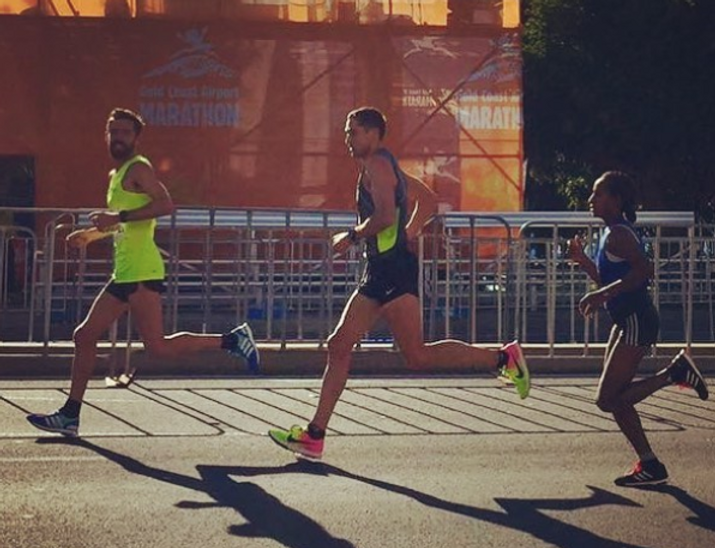
The first half should feel controlled. If the crowd is pulling you along and you're tempted to push, sit on your hands. Save it. The back half is where the real racing happens.
Half Marathon runners: Your race starts Saturday July 4 at 6:15am. Brady's advice for the 21.1 is simple: plan to run the back half faster than the front.
"The first half of a half marathon needs to be more relaxed than the second. Plan to run the last 10km quicker than the first. If you ask yourself at the 10km mark 'Can I hold this pace for another 11km?' the answer should be a confident yes."
Race Week: Do Less, Not More
The biggest mistake runners make in race week is trying to do something. The fitness is banked. The only job now is to arrive at the start line fresh.
Australian marathon record holder and Run2PB coach Andy Buchanan has raced Valencia, London, Paris and beyond. Here's the distilled version of everything he's learned about race week:
Don't do anything new. Literally nothing.
"Just don't do new stuff in that week. Don't go and have a sauna when you never have a sauna, because you'll just cook yourself. Just little things — don't do new stuff."
Same food. Same routine. Same everything. The race is the new thing. That's enough.
You cannot get fitter this week. But you can absolutely wreck it.
"Between now and race day, you're not gonna get any fitter — and you can definitely cook yourself. You'd rather come into a marathon underdone than overdone."

Every unnecessary kilometre or "just checking the fitness" effort is a debt you'll pay on the back half of the course. Less is more.
Make the last long run stupidly easy.
"I really like to take that last long run super chill — really cut back the duration. If you normally run hills or flat, I'd go flat. Just really try and think: how can I make this run as easy as I can?"
Feeling terrible? That's a good sign.
This one matters. Andy has seen it over and over — at the elite level and with his own athletes.
"I've had some of my worst training the week of a marathon. Even the morning when I warm up the day before — those strides suck. I feel clunky as. But then come race day, that run goes off and you're like: holy shit, I feel awesome. That has happened to me more times than I've felt awesome the day before."
He recalls building into Valencia — one of his best ever marathons — feeling awful in Bushy Park the week before. Heavy legs. Cold weather. Nothing clicking. Then race day arrived and everything came together. Taper funk is not a lack of fitness. Don't confuse the two.
Stop looking at the 10-day forecast.
"Don't look at the weather — it's gonna change. You have no impact on it, so why are you stressing about it? There's no harm in having a look the day before to come up with a better race plan, but a week out? Don't even think about it."
Think bigger than this block.
When taper doubt creeps in and you start second-guessing everything, Andy's reminder is worth holding onto:
"Don't just think about this block — think about the block before it, and the block before it, and the block before it. Because those things do add up, and they make a really big difference."
The fitness that will carry you through 42.2km isn't from the last few weeks. It's years of accumulated work sitting in your legs right now.
Logistics: The Stuff That Kills Your Morning If You Wing It
Coach Matt Davy has run this race and coached dozens of athletes through it. His race-week logistics advice is practical and battle-tested.
Pick up your bib early. Head to the ASICS Sport & Leisure Expo at the Gold Coast Convention and Exhibition Centre in Broadbeach on Friday or Saturday. Don't leave it to race morning. Don't spend hours wandering the expo either — you're on your feet, and every unnecessary step is energy you won't get back on course.
Know your transport plan before race morning. The early dark start (6:15am for both the marathon and half marathon on their respective days) means you need to be dialled well in advance. Get the earlier tram. Know your route to the start line. Stress on race morning burns energy and rattles the mind.

Kit sorted the night before. Lay it all out. Every single thing. Shoes, socks, kit, gels, watch, Run2PB Coach Zac Newman puts it simply: know your plan and remove every variable you can control so you can focus entirely on racing.
Aid station strategy. Given the early dark start and the initial crowding at water stations, Matt recommends considering starting with your own water bottles to avoid the chaos of the first few stations. Practice your aid station routine in training. Walking through to grab a cup and not losing time is a skill — and the Gold Coast's warm conditions later in the race mean hydration matters.
As both Matt and Andy say: Don't try anything new on race day. Not your shoes. Not your gels. Not your breakfast. Nothing.
Fuelling: The Practical Guide
Run2PB athlete and Accredited Practising Dietitian Liam Beecroft (2:37 marathoner) joined the Better With Running Podcast to break down exactly how to fuel for a big race. Here's what you need to know.

Race week carb-loading is simpler than you think.
Swap out high-fibre foods and increase your portions of simple carbohydrates. The goal is to top up glycogen stores while keeping bulk low — less fibre means less in your gut on race morning. Liam's personal race morning breakfast includes steamed rice, crumpets with jam, and Nutrigrain. Simple, familiar, tested.
Pre-race fuelling starts the night before.
The work you do the evening before your race is just as important as what you eat on race morning. A carbohydrate-dense dinner is your foundation. For morning fuel, if solids are hard to stomach early, start with liquid carbohydrates and progress from there.

On-course fuelling: practice it, don't experiment on race day.
Liam recommends practising your gel and hydration strategy on easier sessions first to understand your gut tolerance. On race day itself, the Gold Coast's conditions — typically cool at the start but warming through the morning — mean you need to be ahead of your thirst.
"Stop at every cup station."
Especially as the sun comes up and the temperature rises, consistent hydration is non-negotiable. Don't wait until you feel thirsty.
Recovery nutrition starts immediately.
The optimal recovery window is within 30–60 minutes post-race. Both carbohydrates and protein are essential. Liam's overriding message is that nutrition is never optional — even when you don't feel hungry after a hard effort.
"Nothing replaces nutrition, nothing at all."
The Mental Side
Coach Matt Davy talks about the Gold Coast course's toughest mental challenge like someone who has lived it. The 31km mark — where many runners pull out — isn't just a physical test. It's a psychological one. He encourages every athlete to have a plan for that moment.
Visualise it now. Imagine yourself at 31km, feeling it, and pushing through. Have a mantra ready. Know what you'll say to yourself when it gets hard.
Matt's coaching philosophy cuts through the noise:
"If we nail the process, then the win will take care of itself."
Don't get caught up in external pressure, what other people are doing, or the numbers on your watch. Run your race. Trust your plan. And when the race gets tough — because it will — that's exactly when you dig in.
Brady Threlfall's final word from his years on this course:
"Have fun out there, smile when on course, follow the plan you've worked out with your coach — and when it gets tough, that's when you dig deep. Don't be afraid to hurt yourself and get it all out."

After the Race: Don't Wing the Recovery
This part gets overlooked every year. Brady is emphatic about it:
"It's super important to follow a good recovery plan afterwards. The post-marathon training period is always a risky time. In my opinion it's just as important as the taper — and not a time to just wing your training."
Your Run2PB coach will have a recovery plan in place. Follow it. The week after a marathon is one of the highest-risk windows for injury and overtraining. Respect the process on the back end just as you did on the front end.
A Few Final Things
The Gold Coast Marathon is one of Australia's great running events. It's organised, competitive, and spectator-friendly — with incredible fields across every distance from the 2km junior dash all the way to the full marathon. For PB hunters, it's as good as it gets.
The work is done. The hay is in the barn. Now it's time to trust it, run smart, and give everything you have on those flat coastal roads.
See you at the finish line.
Want personalised coaching from an elite athlete with a proven track record of helping runners achieve their PBs? Head to www.run2pb.co and fill out the Sign Up form today.


Comments